


DISSECTING DISASTER- MORTAL KOMBAT- SACRIFICING QUALITY IN SEARCH OF ACCURACY
- Cosmic Critic

- May 4, 2021
- 4 min read
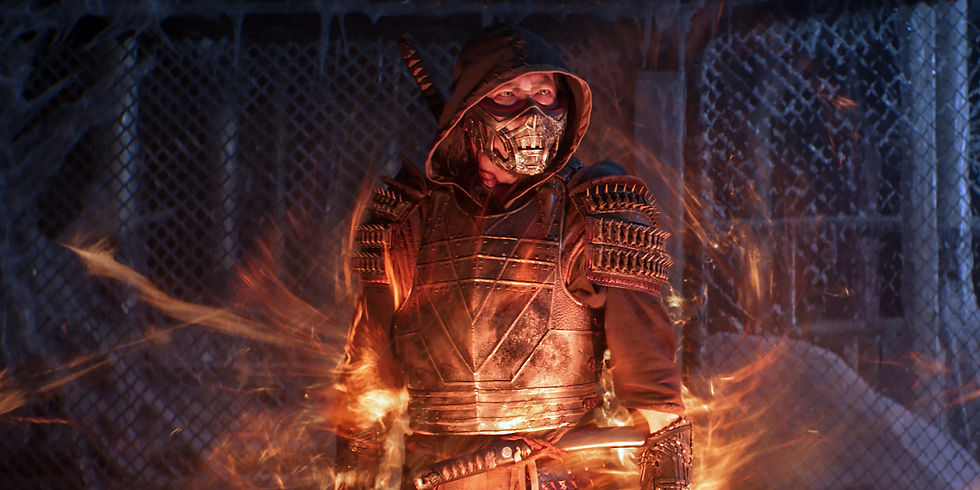
2021’s Mortal Kombat reboot was a world-wide success, becoming the highest grossing HBO max release with strong competitors like ZSJL. However, if there’s one thing that the MCU has taught us, its that money does not equal to quality. Mortal Kombat is a fairly accurate take with plenty of references to the video games and the iconic characters that they feature but in search of accuracy, the movie ended up sacrificing the basics of a good movie which led to its widespread negative reception. In this month’s issue of dissecting disaster, we will be analysing just what exactly went wrong with Mortal Kombat and what it sacrificed for fan service under 3 simple topics:
1. Weak and passive protagonist
2. Non sensical storyline
3. Horrible pacing and structure

WHEN A MOVIE BECOMES AN EPISODE
Mortal Kombat has an excuse of a structure and horrendous pacing. This is apparent by the fact that we don’t even see the actual tournament, just an ambush. Now, there’s nothing inherently wrong with this strategy but it’s something that should be applied to a tv series. Why? Because movies have a greater chance of flopping. If Mortal Kombat did horrible commercially then the sequel would’ve never been green-lit and the story would’ve ended with just a basic ambush. In a tv series, the first few episodes or the first episode can be dedicated to said ambush and we build to the tournament in the later instalments of the season. That way, even if your show flops, you get to the meat of what makes the source material so fascinating in the first place. It’s like ending a Spider-Man movie with Uncle Ben dying. This horrible structure is the fundamental problem with this entry as the basics are completely wrong and ends up only defying the rules of cinema instead of setting a trend like the MCU did for example. The horrible pacing becomes apparent when you notice the time gap between the second act ambush and third act victories. Barely a few minutes. No build up. No development that would make us feel empathetic for these characters in case they lose. No structure or any sense of which scenes deserve to be held on and which ones don’t.

THE PASSIVITY OF THE MAIN AGGRESOR
In every good movie, you have a main character who pushed the plot forward. There are 3 types of protagonists; active protagonists who push the plot like John McClane from Die Hard, passive protagonists who get pushed around by the plot like Peter Parker in Spider-Man Far From Home, and lastly, there are passive aggressive protagonists who transition from a passive to an active protagonist over the course of the movie (especially around the beginning of act 2 A) like young Joe from Looper. Executing passive protagonists to be good is nearly impossible with most of them falling in the passive aggressive category (Joe) or the disappointing characters category (Peter Parker). Mortal Kombat’s frontline character, Cole Young, played by Lewis Tan, falls in the second sub criteria of passive protagonists. For 95% of the movie, he is dragged around, babysat, and ends up in places where the plot conveniently needs him without first earning the destination from embarking on an active journey. The main issue with these characters is that they come off as a product of lazy writing or insufficient development. In most cases, they come off as boring if they don’t have a million-dollar name. Make scorpion a passive protagonists and fans will still cheer but people with basic sense will look past that thin veil of legacy and see the character as the offspring of terrible writing that they truly are.

PLOT ARMOUR WINS! FLAWLESS VICTORY!
The main issue with most adaptations nowadays is that they often barely resemble the source material and are new takes with the same old fundamentals. Mortal Kombat puts his own little twist to this trope and provides a very accurate representation of the characters and the world that they exist in but in doing so, it ends up sacrificing the basics of what makes a movie hold up logically. The movie has way too many logical flaws ranging from, vague rules, inclusion of Raiden when its convenient for the plot, English lessons in hell apparently, people announcing their own victories and describing them, and fellow champions sacrificing themselves to protect another champion though both are of equal value. The problem with Mortal Kombat is that when you’re in a fictional setting, you need to establish some ground rules, or everything becomes a possibility, and the actions of the characters feel non sensical. Other than this, Mortal Kombat tries its darn best to be original by skipping on charismatic protagonists like Johnny Cage and creating a mew character who was set up to be the next Scorpion which was intriguing till you realise that the writers think that originality is always a good thing. In adaptations, you have to be faithful while also being original which is difficult, and MK does its best which is remarkable, but it also contradicts itself and contrasts its own set of rules just to meet the runtime. If the void is a place where the bad guys can’t reach the heroes, then why didn’t they just train there? If Raiden couldn’t intervene when Kung Lao was being killed, then how could he when Cole was? Too many questions, one simple answer. A thick and impenetrable plot armour that ends up rotting the movie from the inside.

Mortal Kombat is a faithful adaptation that true fans of the game will definitely enjoy. It’s an improvement compared to the original films, but unfortunately that isn’t enough as the film falls victim to the video game movie curse, unable to stand out unlike Sonic The Hedgehog. Mortal Kombat has a lot of potential with its incredible roster of wonderful and personable characters but unfortunately, we will have to wait for the sequel to prove this theory right. That concludes this month’s issue of dissecting disaster, I will meet you all next month with two new films to review.


Comments